
The British College: Our Official Position on All Recent Allegations – A Complete Record
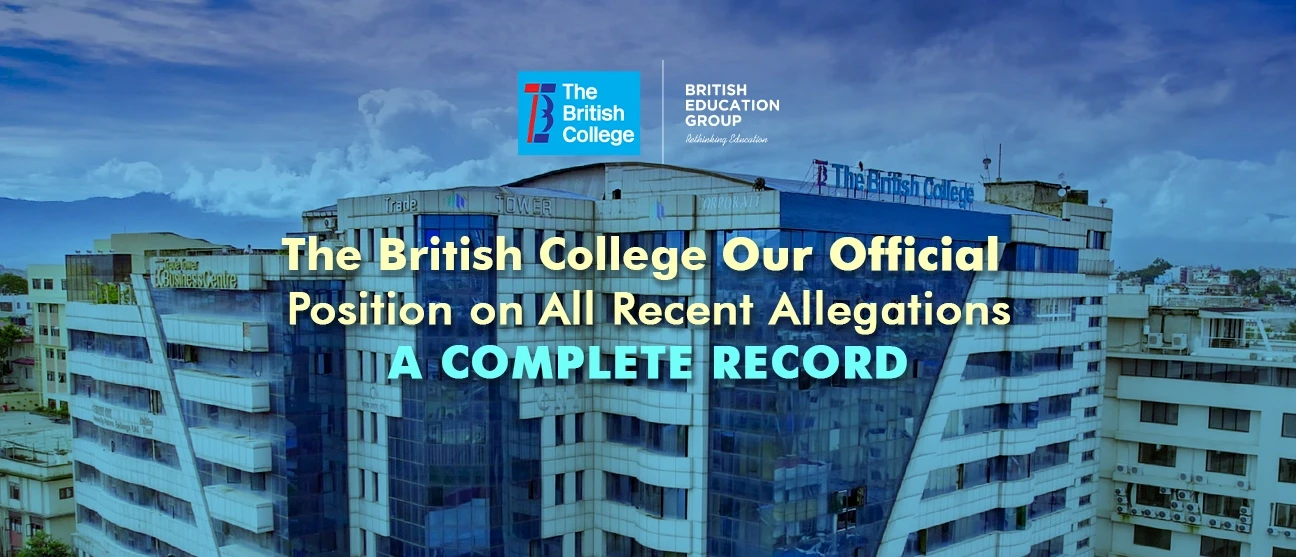
In recent months, The British College (TBC), Kathmandu, has been the subject of significant public discussion following allegations relating to the Hospitality Management international education pathway programme. These discussions have generated understandable concern among students, parents, faculty members, and the wider community.
As an institution dedicated to academic integrity, responsible governance, and student welfare, The British College believes it is essential to present a clear, comprehensive and factual account of the situation.
The purpose of this article is therefore to place the verified facts on public record, clarify misunderstandings that have emerged during the course of the public debate, and provide the latest updates regarding the matter.
We respectfully encourage all stakeholders to consider documented information, official communications, and verified testimonies when evaluating this issue.
The British College’s Commitment to Academic Integrity
Since its establishment in 2011, The British College has been committed to providing students in Nepal with access to internationally recognised higher education through partnerships with leading UK universities.
The College recognises that students and their families place immense trust in educational institutions when making decisions about their future. As such, the College considers it its responsibility to address concerns transparently and to ensure that accurate information is available to all stakeholders.
Our commitment remains unchanged:
- to maintain high academic standards
- to support students throughout their educational journey
- to cooperate fully with regulatory authorities
- to communicate openly when questions arise
Understanding the Government Review
Much of the public discussion has centred on media reports stating that a government study had “found irregularities” at The British College.
However, according to the latest information available to the College, Nepal’s Ministry of Education, Science and Technology has not accused The British College guilty of illegality, licence breach, or regulatory misconduct.
Instead, the Ministry conducted a review process that resulted in recommendations directed both to The British College and to foreign-affiliated educational institutions operating in Nepal more broadly.
These recommendations form part of a 10-point policy directive aimed at strengthening regulatory oversight for international academic partnerships across the sector.
Such policy guidance reflects the evolving landscape of transnational education in Nepal and should not be interpreted as confirmation of irregularities.
Distinguishing Preliminary Observations from Formal Findings
A closer examination of the review process suggests that some of the early commentary originated from internal working notes prepared during the Ministry’s review stage.
These preliminary observations were not conclusions. However, in certain instances, they were interpreted publicly as confirmed findings.
The British College maintains that these early remarks likely reflected initial confusion regarding the structure of British pathway education models and international regulatory systems, which differ significantly from the traditional university structure in Nepal.
Administrative observations made during a regulatory review do not necessarily indicate institutional misconduct.
Understanding British Pathway Education
At the centre of the discussion are foundation programmes and Higher National Diplomas (HNDs).
These qualifications are widely used within the British higher education system as recognised academic pathways that allow students to progress to university degrees.
The academic structure involved in this programme consisted of three stages:
- Students completed a foundation programme in Nepal.
- Students then enrolled in a Pearson-awarded Higher National Diploma (HND) delivered at The Woolwich Institute (TWI) in Dubai.
- Upon successful completion of the HND, students could apply for final-year top-up bachelor’s degree programmes internationally, subject to academic and visa requirements.
Pearson HND qualifications are globally recognised and are commonly used by students worldwide as a pathway to university degree completion.
TBC, Kathmandu, Nepal, reiterates that no student was promised guaranteed progression to any specific named university, and the College maintains that there is no documentary evidence supporting such claims.
Clarifying the UAE Regulatory Frameworks
Another source of confusion appears to have arisen regarding the regulatory framework governing education institutions in Dubai.
Dubai’s private education sector is regulated by the Knowledge and Human Development Authority (KHDA).
The Woolwich Institute, where students continued their HND studies, is licensed by KHDA, which oversees private education providers in the emirate.
Some public discussions referred to the Commission for Academic Accreditation (CAA) under the UAE Ministry of Education. However, CAA accreditation is not legally required for all institutions operating within Dubai’s KHDA-regulated education framework.
Administrative restrictions regarding No Objection Certificates (NOCs) imposed by Nepali authorities on certain non-CAA institutions relate to Nepal’s internal regulatory procedures and do not invalidate institutions legally licensed under Dubai law.
Events on Campus: Escalation of the Situation
During the period when regulatory clarification was ongoing, events at the College campus escalated.
According to internal reviews and police records, what began as a limited number of student queries gradually intensified over several days.
Reports indicate that individuals not affiliated with the academic programme entered the campus premises, including individuals reportedly linked to student wings of various political organisations.
The situation escalated into disorder and property damage, prompting police intervention to restore order.
Law enforcement authorities made several arrests in connection with the incident. According to police documentation, a former student was arrested under Section 253 of Nepal’s National Criminal Code relating to extortion.
These developments suggest that the situation had extended beyond an ordinary academic grievance.
Recent Developments Reported in the Media
In the weeks following the initial public controversy, several additional developments have emerged that provide further context to the situation.
Law enforcement authorities became involved after incidents of disruption and intimidation occurred on campus during the period of heightened tensions. Police intervention was required to restore order after individuals who were not affiliated with the academic programme reportedly entered the College premises during the agitation. Investigations were initiated into these events, and authorities took steps to ensure the safety of students, staff, and property.
Subsequent media reports have also revealed new information regarding the spread of misinformation during this period. Notably, Danphe Nepal TV, a media outlet that had broadcast a series of critical video content related to The British College, issued a formal written apology to the institution. According to the official letter sent by the media organisation’s management, some of the materials had been broadcast without adequate verification of facts or a full understanding of the circumstances surrounding the issue.
In its statement, the media outlet acknowledged that certain content had been prepared based on information and pressure from individuals and students without sufficient fact-checking, and the organisation accepted responsibility for the error. The letter further expressed an unconditional apology to the College management, teachers, students, parents and all stakeholders for the institutional and reputational harm caused by the dissemination of inaccurate information.
As a corrective measure, the media organisation confirmed that it had decided to remove all videos and related materials concerning The British College from its digital platforms.
At the same time, legal proceedings connected to the campus incidents have continued. Reports indicate that a former student accused of attempting to extort approximately NPR 3 million from the College by threatening reputational harm has been taken into police custody, and investigations are ongoing. Authorities are examining the circumstances surrounding these actions as part of the broader inquiry into the disturbances.
These developments suggest that the situation surrounding the controversy involved a combination of regulatory misunderstanding, misinformation circulating in public discourse, and external interference during campus unrest. While the regulatory review process was underway, these incidents contributed to increased public attention and further complicated the narrative surrounding the matter.
The British College continues to cooperate fully with the relevant authorities and remains committed to ensuring that accurate information is made available to all stakeholders as the situation evolves.
Student Experiences in Dubai
It is important to recognise that students' experiences in the Dubai pathway programme have not been uniform, and several students currently studying in Dubai have publicly shared their perspectives in response to online claims. Their statements provide additional context and show that the situation is more nuanced than some public narratives suggest.
Shreya Poudel explained that she initially chose not to speak publicly but felt compelled to do so after witnessing what she described as widespread misinformation regarding the programme. She stated that the academic arrangements and support provided by the College had met her expectations and that she and her classmates were continuing their studies in Dubai as planned.
Pratiksha Lama shared that she had successfully secured an internship at Media One Hotel, a well-known hospitality establishment in Dubai, with support from the programme. Her experience reflects the intended objective of the programme—to combine academic study with practical exposure to the hospitality industry.
Similarly, Tripti Bhandari expressed that the situation portrayed in some public discussions did not reflect her own experience. She indicated that she did not support the calls for protest and believed that many of the claims circulating online did not accurately represent the realities faced by students currently pursuing their studies.
Suchana Paudel also commented on the accommodation arrangements provided to students, describing them as safe and consistent with the contractual terms communicated prior to travelling to Dubai. According to her statement, the housing arrangements aligned with the expectations outlined during the programme briefing.
Nirmal Ranjit addressed allegations that students had been forced to sleep on the streets. He rejected these claims and explained that while a small number of students faced accommodation challenges after the initial accommodation period arranged by the programme had concluded, this situation arose because some students had not made timely arrangements for alternative housing. He emphasised that such circumstances did not reflect the general experience of the student group.
According to available records, 51 students travelled to Dubai as part of the programme. Of these, nine students returned to Nepal, while two later chose to return to Dubai to continue their studies. The majority of the cohort remains enrolled in Dubai and continues to pursue their academic and professional development within the programme.
These testimonies highlight that student experiences have varied and underscore the importance of considering multiple perspectives when evaluating the circumstances surrounding the programme.
Accommodation and Internship Arrangements
The British College, Nepal, maintains that accommodation and internship support were provided in accordance with the terms and conditions outlined in the programme documentation prior to students travelling abroad. Students were informed about the nature of the arrangements during the orientation and briefing process, and these details were also included in the relevant programme materials.
Accommodation was arranged for students upon arrival in Dubai in line with the provisions communicated before departure. The housing facilities were organised to ensure appropriate living conditions for students, including separate accommodation arrangements for male and female students in order to maintain privacy and safety. These arrangements were intended to provide a supportive and secure environment as students began their studies and adjusted to living in a new country.
In addition to accommodation, the programme included internship support designed to provide students with practical exposure to the hospitality industry. This support involved guidance in identifying potential internship opportunities, assistance with applications, and coordination with industry partners where possible. The objective was to help students gain valuable real-world experience alongside their academic studies.
However, it is important to clarify that, as is common practice within the global hospitality sector, specific job placements or internship positions cannot be contractually guaranteed. Internship outcomes depend on several factors, including employer selection criteria, student performance during interviews and training, visa and employment regulations, and prevailing labour market conditions. While institutions and programme partners can facilitate opportunities and provide support, final hiring decisions remain with the employers.
The British College emphasises that the programme’s intention has always been to provide students with a pathway that combines academic learning with industry exposure, while also ensuring that students receive the guidance and support necessary to pursue professional opportunities during their time abroad.
Actions Taken by The British College
Throughout this period, The British College has taken several steps to address student concerns, clarify misunderstandings, and ensure that accurate information is communicated to all stakeholders. The College recognises the importance of responding responsibly during times of uncertainty and has therefore prioritised open dialogue and institutional transparency.
Among the measures taken were direct communication with students and their families, including individual discussions and group meetings to understand concerns and provide clarification about the programme structure and expectations. The College also organised formal meetings and consultation sessions where students were able to raise questions and receive detailed explanations from academic and administrative representatives.
In parallel, The British College maintained full cooperation with the relevant regulatory authorities, providing information and documentation required during the review process. Internally, the institution also conducted a review of programme procedures and communication practices to ensure that policies, documentation, and briefing processes remain clear and consistent for all students.
Where appropriate, the College explored possible resolution pathways for students who expressed concerns, including academic guidance, counselling support, and assistance in evaluating alternative academic options where necessary. These steps were taken with the aim of ensuring that every student receives the support needed to continue their educational journey.
To ensure complete transparency and provide stakeholders with a detailed account of the matters, The British College has also issued an Official Detailed Clarification Statement outlining the institution’s position, supporting documentation, and explanations regarding the programme structure and recent developments. We encourage students, parents, partners, and members of the public to review this statement in full in order to gain a comprehensive understanding of the situation based on verified information and official records.
View Documents:
Current Status of The British College
Despite significant media attention and public discussion surrounding the issue, academic operations at The British College continue without interruption. The College remains fully operational, and teaching and learning activities across all departments are proceeding as scheduled.
Undergraduate and postgraduate programmes delivered in partnership with internationally recognised UK universities continue to be conducted in accordance with established academic standards and institutional frameworks. Students across all programmes remain actively engaged in their studies, and the academic calendar continues to progress normally.
It is also important to note that the Ministry of Education, Science and Technology has not issued any official determination declaring the College to have committed institutional misconduct or regulatory violation. The situation appears to have largely arisen from differing interpretations of administrative observations made during the review process and from misunderstandings regarding international pathway education models.
TBC, Nepal, continues to cooperate with regulatory authorities and remains committed to ensuring compliance with all relevant policies and procedures governing higher education institutions in Nepal.
The Broader Context: International Education in Nepal
The situation has also drawn attention to broader questions regarding the development and regulation of foreign-affiliated higher education institutions in Nepal. As international education partnerships become more common, the regulatory landscape continues to evolve to accommodate a wider range of academic structures and collaborative arrangements.
Transnational education models, including foundation pathways, international diplomas, and cross-border academic collaborations, are widely used in global higher education systems. However, such models are still relatively new within Nepal’s traditional university framework, which can sometimes lead to differences in interpretation and regulatory complexity.
The ongoing discussions between educational institutions and government authorities may ultimately contribute to clearer guidelines and improved regulatory frameworks for international academic partnerships. Such developments could strengthen the governance of foreign-affiliated programmes and support the continued growth of globally connected higher education opportunities for students in Nepal.
Reaffirming Our Commitment to Students
The British College fully recognises that recent events may have created uncertainty for students, parents, and members of the wider community. We understand that higher education decisions involve significant personal and financial commitments, and we remain deeply committed to maintaining the trust placed in us by our students and their families.
In light of this, we reaffirm our commitment to:
- maintaining transparent and responsible communication with students and stakeholders
- supporting students throughout their academic and professional journey
- working constructively with regulatory authorities and educational partners
- continuously reviewing and strengthening institutional processes and student support systems
At The British College, students remain at the centre of every decision we make. Their academic success, well-being, and future opportunities continue to guide our institutional priorities.
Moving Forward
Periods of public scrutiny can often give rise to misinformation or incomplete narratives. While such situations can create uncertainty, they also provide an opportunity for institutions to reaffirm their commitment to transparency, accountability, and open dialogue.
The British College believes that the most responsible response in such circumstances is to rely on verified facts, respectful communication, and cooperation with relevant authorities. By doing so, institutions can ensure that discussions remain grounded in evidence rather than speculation.
Looking ahead, The British College remains dedicated to providing students in Nepal with access to internationally recognised education, practical industry exposure, and meaningful career opportunities. We will continue to engage constructively with regulators, support our students, and uphold the academic values that define our institution.
About The British College
The British College (TBC), Kathmandu, is one of Nepal’s leading international higher education institutions, dedicated to providing students with access to globally recognised British degrees and international academic standards within Nepal. Since its establishment, the College has sought to bridge the gap between Nepal’s education system and the global academic landscape by offering programmes that combine rigorous academic learning with practical industry relevance.
TBC delivers undergraduate and postgraduate programmes through strategic partnerships with respected UK universities, ensuring that students receive qualifications that meet internationally recognised academic frameworks and quality assurance standards.
One of the College’s long-standing academic partners is the University of the West of England (UWE Bristol), a highly respected UK university known for its strong emphasis on employability, research, and industry engagement. Through this partnership, students at The British College are able to pursue UWE Bristol-awarded degrees in fields such as business, computing, and data science while studying in Kathmandu. These programmes follow the same academic structures, quality assurance processes, and assessment standards that apply to students studying at UWE Bristol in the United Kingdom.
The British College has also established a partnership with Keele University, one of the United Kingdom’s leading research-led universities, known for its interdisciplinary teaching approach and global outlook. This collaboration further expands opportunities for students to pursue internationally recognised qualifications while benefiting from the academic expertise and reputation associated with a well-established UK institution.
In addition, The British College maintains an academic relationship with Leeds Beckett University, another prominent UK university with a strong reputation for applied learning, professional development, and industry-focused education. Through this partnership, TBC students benefit from exposure to internationally recognised teaching methodologies and academic leadership from experienced scholars and practitioners.
These partnerships ensure that the programmes delivered at The British College are aligned with international quality assurance standards, modern curriculum design, and global academic expectations. Students are taught by experienced faculty members and benefit from teaching approaches that emphasise critical thinking, practical application, and real-world problem solving.
Beyond academic delivery, The British College places significant emphasis on student support and professional development. The institution provides a range of services, including academic guidance, career counselling, student wellbeing support, and opportunities for industry engagement. These services are designed to help students navigate their academic journey successfully and prepare for professional careers after graduation.
Through its international partnerships and industry-focused learning environment, The British College aims to equip students with the skills, knowledge, and global perspective required to succeed in an increasingly interconnected world. Graduates of the College pursue careers in Nepal and internationally across sectors such as business, technology, finance, hospitality, and data science.
Our mission remains clear: to provide students in Nepal with access to world-class education, internationally recognised degrees, and meaningful career opportunities that extend beyond national borders.
For more information, please contact us:
The British College, Trade Tower Business Centre, Thapathali, Kathmandu, Nepal
Tel: +977-1-5970003 | Fax: +977-1-5111103
Email: info@thebritishcollege.edu.np
URL: www.thebritishcollege.edu.np
Visit us: