
The British College Receives BAC Re-Accreditation, Reaffirming Its Commitment to International Quality Standards
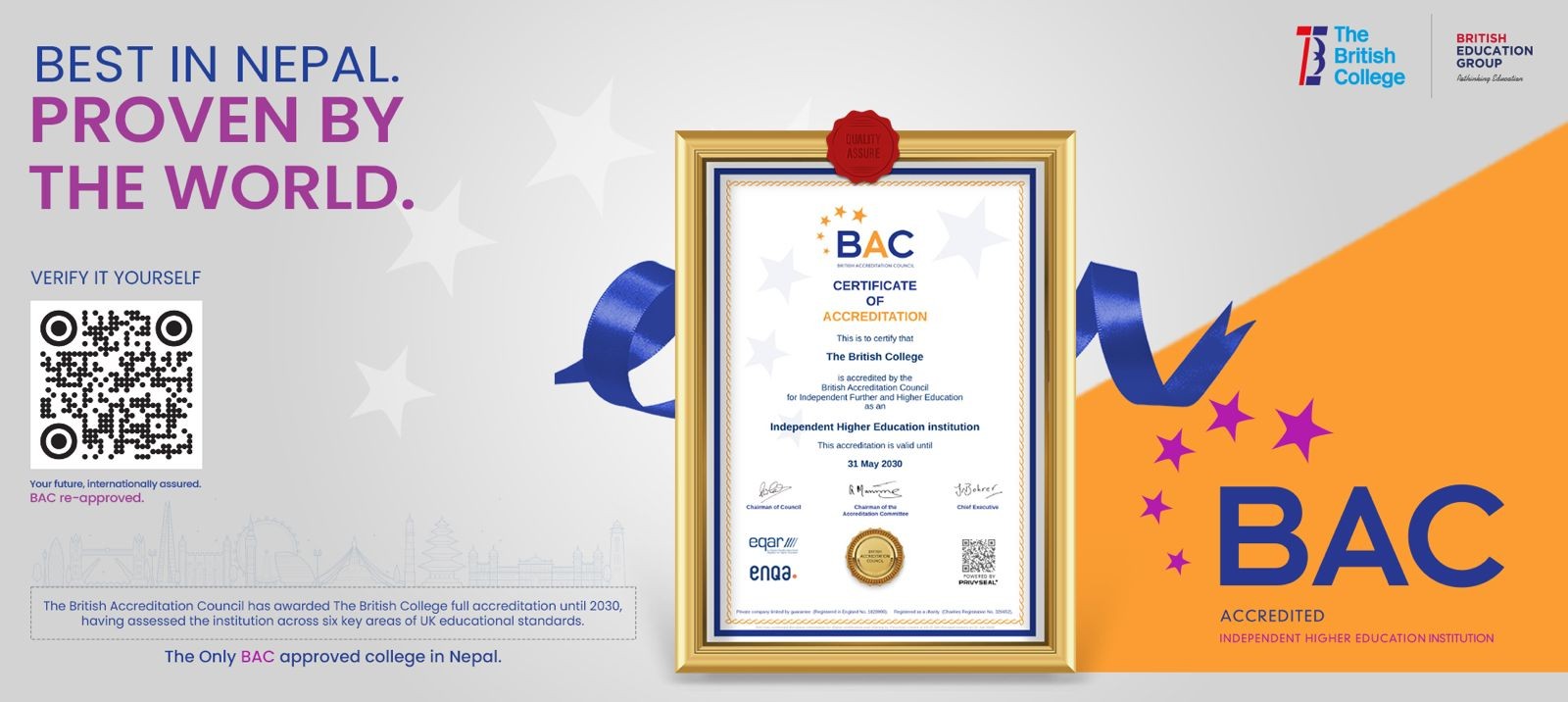
The British College (TBC), part of the British Education Group (BEG), has officially received re-accreditation from the British Accreditation Council (BAC) as an independent higher education institution.
This makes The British College the first and only higher education institution in Nepal to hold this prestigious accreditation, which is now valid until 31 May 2030.
The achievement is a historic milestone not just for The British College, but for Nepal's higher education sector as a whole.
What Is the British Accreditation Council?
The British Accreditation Council is an independent quality assurance body based in the United Kingdom. Established in 1984 by the UK's Department of Education and the British Council, it has set and maintained rigorous standards for independent further and higher education institutions for over 40 years, both in the UK and internationally.
BAC is a full member of ENQA (European Association for Quality Assurance in Higher Education) and INQAAHE (International Network for Quality Assurance Agencies in Higher Education). These memberships reinforce its standing as a globally recognised accreditation body.
When an institution receives BAC accreditation, it sends a clear message: that institution has met internationally recognised quality benchmarks and operates to high standards across all areas of its work.
BAC accreditation is widely recognised as a prestigious mark of educational quality, integrity, and institutional excellence. It is awarded only to institutions that demonstrate strong academic systems, effective governance, robust quality assurance processes, and a clear commitment to continuous improvement.
Importantly, BAC accreditation is not a one-time recognition. Accredited institutions are subject to ongoing monitoring and periodic inspections throughout the accreditation period to ensure they continue to meet BAC's high standards.
How Was the Accreditation Awarded?
The re-accreditation followed a comprehensive institutional inspection conducted by a team of BAC inspectors from the United Kingdom.
The review was detailed and wide-ranging. It covered every aspect of the college's operations, academic programmes, teaching quality, governance, student support, learning resources, campus facilities, online provision, extracurricular activities, and graduate employability.
Staff and students at the college were also directly involved in the inspection process, making this a thorough, institution-wide evaluation.
To achieve accreditation, The British College had to meet BAC's stringent standards across six key areas:
- Governance, Strategy and Financial Management
- General and Academic Management and Administration
- Teaching, Learning and Assessment
- Student Support, Guidance and Progression
- Premises, Facilities and Learning Resources
- Quality Management, Assurance and Enhancement
Only after satisfying all six areas did BAC's independent Accreditation Committee award the accreditation.
It is also important to note that BAC does not accredit individual courses or programmes. It accredits the institution as a whole, evaluating the overall quality, management, student experience, and academic standards across all operations.
Why This Matters for Students
For students and their families, this accreditation carries real weight.
It is independent confirmation from an internationally respected body that The British College meets globally recognised benchmarks for educational quality and institutional effectiveness.
In simple terms, it means that when you study at The British College, you are at an institution that has been independently assessed and found to meet high international standards. Not just in teaching, but in student support, facilities, governance, and the overall learning experience.
BAC-accredited institutions demonstrate effective governance, strong systems, and a clear commitment to continuous quality improvement. That matters when choosing where to invest your time and education.
Studying at a BAC-accredited institution offers several key benefits:
- Assurance of quality and reliability
- Internationally recognised educational standards
- Better student support and learning experience
- Enhanced credibility of your qualification
- Access to a global network of quality providers
This recognition underscores the college's dedication to providing students with a world-class, student-centred educational experience that meets international benchmarks.
Lucy Fox, Deputy Chief Executive of the British Accreditation Council, commented:
"BAC accreditation demonstrates that an institution has undergone a rigorous independent assessment against the BAC accreditation scheme standards, covering areas such as academic management, quality assurance, student welfare and institutional governance. Accreditation reflects a commitment to maintaining clear standards and supporting a quality student experience. The British College has been accredited by BAC since 2021, and we congratulate the institution on its successful re-accreditation."
What the College's Leadership Said
Dr Declan P. Bannon, Academic Dean at The British College, spoke about what this achievement represents for the institution:
"Receiving BAC accreditation is an important and proud milestone for The British College. It recognises the strength of our academic systems, the dedication of our faculty and professional teams, and our ongoing commitment to delivering education that meets internationally recognised standards. Most importantly, it assures our students that quality and academic excellence remain central to our mission."
Rajen Kandel, CEO and Founder of The British College and British Education Group, described the accreditation as a landmark moment for Nepal's higher education sector. He reiterated the institution's commitment to adopting international best practices and contributing to the advancement of higher education in Nepal:
"We are proud to be the first college in Nepal to achieve this accreditation, and looking ahead, we aspire to implement numerous international best practices to contribute to the advancement of education in Nepal."
A Historic Milestone for Nepal's Higher Education Sector
This re-accreditation is significant beyond The British College itself. It represents independent, international validation that a Nepali institution is continuously upholding globally recognised standards and best practices in higher education.
That is an important benchmark not only for the college but for the students, parents, employers, academic partners, and the general public who place their trust in it.
It is also worth noting that earlier this year, the college faced a coordinated campaign by an organised group that sought to spread misinformation and mount an extortion attempt against the institution. This led to some disruptions, multiple arrests, and legal proceedings against the perpetrators.
Despite this, following a comprehensive and independent inspection by UK-based BAC inspectors, the college has been awarded re-accreditation through to 2030.
The outcome sends a clear message to students, parents, employers, academic partners, and the wider public: The British College continues to meet globally recognised benchmarks for educational quality and institutional effectiveness. The re-accreditation reconfirms, at an international level, the college's standards and operations.
Building on a Strong Foundation
As a member of the British Education Group, a network committed to delivering high-quality international education across Nepal and beyond, The British College has consistently built its reputation through internationally recognised degree programmes, strong partnerships with leading UK universities, active industry engagement, and a commitment to preparing graduates for success in an increasingly global world.
The BAC re-accreditation further validates these efforts.
It reinforces the institution's position as one of Nepal's leading institutions for internationally aligned higher education. It also further strengthens trust and confidence among students, parents, academic partners, employers, and the general public.
For students choosing where to study, this accreditation provides an added layer of confidence. It is independently verified proof that The British College continuously upholds internationally recognised standards of educational quality and institutional effectiveness.
Frequently Asked Questions
1. What is the BAC?
The British Accreditation Council (BAC) is an independent body that sets and maintains quality standards in the independent further and higher education sector. Established in 1984 by the UK's Department of Education and the British Council, BAC has been operating for over 40 years. It is a full member of ENQA and INQAAHE and is recognised internationally as a mark of educational quality.
2. What does BAC accreditation mean?
BAC accreditation is a rigorous external quality assurance process. It confirms that an institution meets high global standards across all areas of its operation. For students, it assures that they are studying at a trusted, reliable, and high-quality institution.
3. Is The British College accredited by BAC?
Yes. The British College is accredited by the British Accreditation Council (BAC) and is the first college in Nepal to achieve this internationally recognised quality assurance accreditation, valid until 31 May 2030.
4. What does BAC accreditation mean for students at The British College?
For students, BAC accreditation means studying at an institution that has been independently assessed and recognised for meeting internationally benchmarked quality standards. It demonstrates The British College's commitment to providing a high-quality, student-centred educational experience and continuous improvement.
5. Does BAC accredit individual courses?
No. BAC focuses on institutional accreditation rather than accrediting individual programmes. This means it evaluates the overall quality, management, student experience, and academic standards of the institution as a whole.
6. What areas does BAC inspect?
To achieve and retain accreditation, institutions must meet BAC's standards in six key areas:
- Governance, Strategy and Financial Management
- General and Academic Management and Administration
- Teaching, Learning and Assessment
- Student Support, Guidance and Progression
- Premises, Facilities and Learning Resources
- Quality Management, Assurance and Enhancement
7. How does an institution get BAC accredited?
Institutions undergo a thorough inspection by experienced higher education experts. A detailed report is then reviewed by BAC's independent Accreditation Committee, which decides whether to award accreditation.
8. Why is BAC accreditation important for students?
It gives you confidence that the college:
- Meets internationally recognised quality standards
- Maintains high standards in teaching, student support, and resources
- Has proper governance and financial management
- Is committed to continuous improvement
9. What are the benefits of studying at a BAC-accredited institution?
- Assurance of quality and reliability
- Internationally recognised educational standards
- Better student support and learning experience
- Enhanced credibility of your qualification
- Access to a global network of quality providers
10. Is BAC accreditation recognised internationally?
Yes. BAC is an internationally respected body. Its accreditation is valued by students, parents, employers, and education partners in many countries as a guarantee of quality.
11. How often is accreditation reviewed?
BAC accreditation is not awarded permanently. Accredited institutions undergo regular monitoring and periodic inspections to ensure they continue to meet BAC's standards and maintain educational excellence.